Many feared that the ongoing confrontations across the country between ICE and activists would lead to something horrible. That outcome came to fruition on Jan. 7, when Renee Good died after being shot in her car by an ICE agent.
Almost immediately, partisans rushed to judgment, proffering the most extreme, caricatured versions of events imaginable. Homeland Security Secretary Kristy Noem said Good was a domestic terrorist endangering national security. On the other side, Democrats like Jasmine Crockett and Chuy Garcia accuse ICE of carrying out state-sanctioned executions or murder.
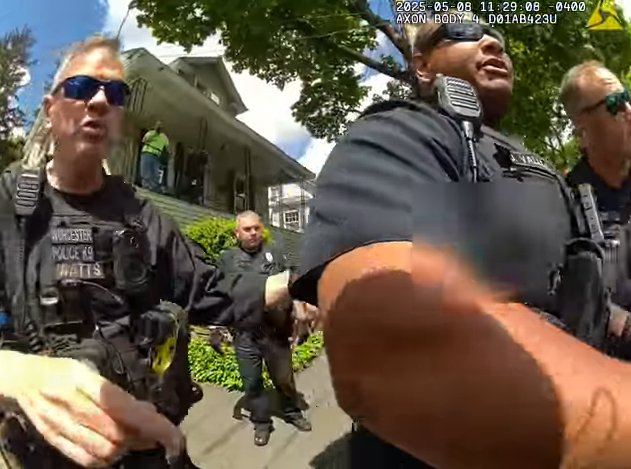
The conversation was similar after the incident between ICE and protesters on Eureka Street in Worcester this past May. Local Facebook forums have been full of comments demonizing either the ICE agents, the local police, the protesters, or some combination thereof.
That extreme partisanship drowned out civil discussion. No one seems to have noted that there was a key distinction between what happened in Minneapolis and the case in Worcester: the involvement of local law enforcement.
The two situations bore much in common. In Minneapolis, ICE agents appeared in a residential neighborhood to detain an individual suspected of being in the U.S. illegally. It was the same in Worcester: ICE arrived on Eureka Street, looking to arrest Brazilian national Rosane Ferreira de Oliveira. In both cities, local activists sounded the alarm, calling for others to come to the scene.
In Worcester, the local activists, including former city council member Etel Haxhiaj, attempted to confront the federal agents on Eureka Street. Unlike in Minneapolis, the local police had already been summoned. They worked to keep the ICE agents and the local activists apart.
In the weeks and months following the Eureka Street incident in Worcester, controversy swirled. Local progressives condemned the Worcester Police Department for “assisting” ICE. Others, including Mayor Joe Petty, disagreed.
Petty told Spectrum News, “The police are not allowed to assist ICE when it comes to apprehending and detaining people for immigration enforcement reasons, but assisting ICE and crowd control are two different things.”
Many of Worcester’s progressive and activist leaders condemned Petty for, in their estimation, supporting ICE and trying to obscure some tacit cooperation between the city and immigration agents. But the distinction Petty made is important. It isn’t the job of local police to carry out federal policy, but it is their duty to control crowds – especially when a confrontation between two opposing sides seems likely.
Progressives criticized Petty for saying, “I’m just glad nobody got hurt.” As it turns out, though, his words were prescient. As Minneapolis showed, things on Eureka Street could have spiraled out of control, ending not with an ICE detainer and a few arrests, but bloodshed.
Regardless of what anyone thinks of ICE’s tactics in American cities – and this author has many problems with those tactics – there is a simple fact. Standoffs with federal agents tend to spiral out of control. That’s what happened in 2014 during the Bundy standoff, in 1993 in Waco, in 1992 in Ruby Ridge – and, sadly, now in 2026 in Minneapolis.
Thankfully, the police kept the city from falling into that pattern. Since the incident at Eureka Street, there has been fallout. Haxhiaj was charged with assaulting an officer. The president of the local police union, Thomas Duffy, is suing journalist Tom Marino for defamation. Perhaps most egregiously, a mob of protesters took over City Hall, forcing a city council meeting to adjourn.
Despite the acrimony, Worcester residents can at least be thankful that none of the fallout involved body bags.