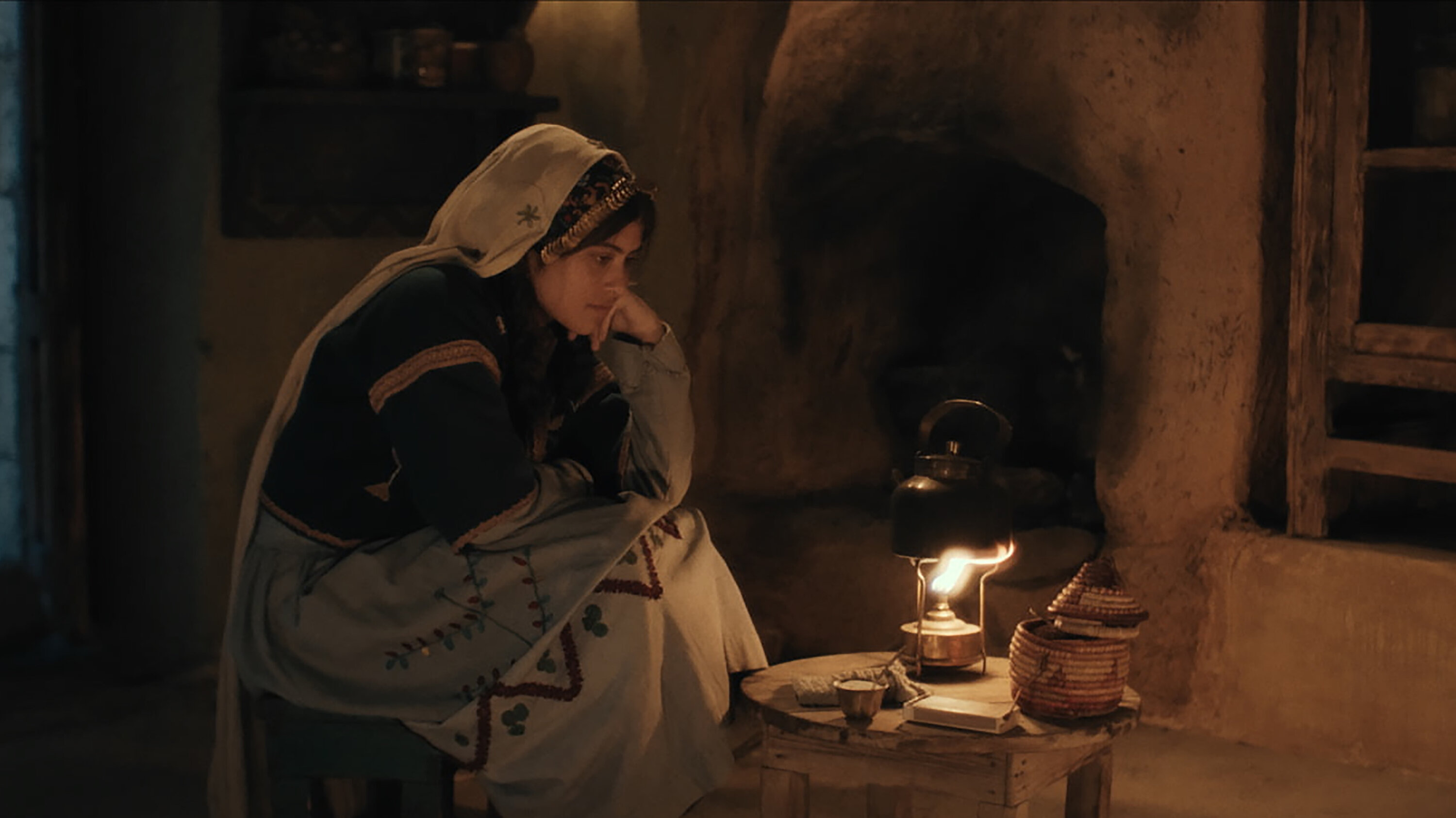
If you make it through the entirety of Farha, the controversial Jordanian film about a young Palestinian girl during the conflict of 1948, and then watch the credits, you’ll find something curious. The extras are listed as residents of the “Gaza Refugee Camp” in Jerash, Jordan. This movie, supposedly in solidarity with the plight of Palestinians, was made in and financed by a country that keeps hundreds of thousands of them locked in refugee camps. That’s fitting. The filmmakers, along with the Jordanian and other governments, care less about Palestinians than about using them as a tool to demonize Israel and Jews.
Farha is nothing more than propaganda, and boring propaganda at that. The film is ridiculously one-sided, even slanderous, in its depiction of the military units that later became the Israel Defense Force. While there is a conversation to be had about the situation around the creation of the State of Israel and the conditions that led to the hundreds of thousands Palestinian Arabs displaced from their homes, Farha paints a Manichean picture, in which benevolent Arab villagers are mercilessly slaughtered by carnage-loving Jews.
The plot, centering on the eponymous teen girl, is simple. Farha wants to leave her village in Mandatory Palestine to go study in the unnamed “city,” presumably Jerusalem. Alas, it’s 1948, and the devious Jews attack her town. Though her father tries to send her away with her uncle and his family, she flees the escape car to stay with him. To keep her from danger, he locks her in a food storage cellar, promising to return. The rest of the movie tediously chronicles Farha’s days in the cellar. For most of the movie, the viewer desperately waits for anything to happen while watching a girl mill about in a basement. Farha cries, goes to sleep, wakes up, her lamp runs out of oil, she runs out of water, she collects rainwater, and on and on…and on.
While supposedly based on true events, there is very little actual historical detail presented. Early on, Farha and her cousin see a convoy of British soldiers as they are leaving the country, prompting her and other village kids to mock the soldiers and cheer their withdrawal. The average American, unfamiliar with the intricacies of the conflict, must surely wonder: why are these British soldiers there? Why are they leaving? Those who know a bit more might suspect that the villagers were cheering some kind of Arab victory in pushing the British out. That seems to be the notion the filmmakers want to present, but it’s a false one. Few Arabs actually sided with the British – indeed, Jerusalem’s Grand Mufti Mohammed Amin al-Husseini was an open supporter of Hitler and recruited locals to fight in the Third Reich’s army – but the Jewish military organizations the film slanders were the ones who actually expelled the British, as documented in Menachem Begin’s The Revolt and in Britain’s own contemporaneous statements at the UN.
The film’s fudging of the historical record is the least of its flaws, however. Much more distressing is the blood libel. In the film’s central scene, Farha, watching through an opening in the cellar door, sees Jewish soldiers capture an Arab couple from the village. The Jews – the filmmakers, who aim for historical accuracy nowhere else, do not neglect to ensure that the proto-IDF are speaking Hebrew – laugh and taunt the woman. Believing her to be pregnant, the fighters place a bet as to whether the baby is a boy or a girl, deciding to gut her to find out. However, a baby cries out from above; they realize the woman has actually just given birth and hidden the baby. The Jews then find the newborn and their two other children. After more taunting, the soldiers line everyone but the baby against the wall and shoot them.
As they prepare to depart, the commander tells his subordinate to kill the baby, but not “to waste a bullet.” The soldier places the baby on the ground, throws a towel over it, and leaves. Later, when Farha breaks out of the cellar, she finds the baby dead, covered in flies.
Aside from being one sided, Farha engages in some pretty blatant antisemitism – but is its core story true? Probably not. According to the film’s opening, it was “inspired by true events.” But “inspired” is a weasel word; which part was true, and which was simply inspired? And of the events that the filmmaker actually believed to be true, was it really? Perhaps there was a girl who hid in a food cellar. There is no documentation of anything that happened, and new scholarship tells us that many well-known “truths” of Israeli brutality were nothing more substantial than rumors that swirled during wartime, later amplified by various interests.
What’s more, filmmaker Darin Sallam said that there were “parallels” between her film’s story and the life of Anne Frank. This analogy is troubling, as the logical conclusion is that, if this girl is Anne Frank, the Israelis are to be taken as the Nazis. According to the definition of antisemitism agreed upon by the United States and dozens of other countries, comparisons between Israelis and the State of Israel to Nazis quite often is rooted in antisemitism.
Farha was produced under monarchy, and liberal democracies tend to produce better movies than authoritarian regimes.* Compare, for example, this misfortune of a film with the series Fauda, produced next door, in Israel. The latter, about the current stage of the Israeli-Palestinian conflict, is layered and rich, and every character on any side is a multi-faceted human being with complex motivations. Fauda is not without bias; it is as pro-Israel as Farha is pro-PLO. The difference is that in the world of Fauda, the Israelis are on the right side of the conflict, but they are imperfect, and the Palestinians are real human beings caught between sides in a situation they wouldn’t choose for themselves. In Farha, the Arabs are good and the Jews are monsters who like to kill.
Given that Farda’s “true” story is highly unlikely to be so, the closest we come to a crime against humanity is the producers and Netflix causing anyone to endure this film. Stripped of its anti-Israel and antisemitic sentiment, the film is just a bore, its brief 92-minute runtime seeming to stretch to hours.
Whatever one thinks of the conflict, whichever position one takes on who the actual aggressor is, the Palestinians deserve to have their stories told. Compelling films showing their plight – as well as their human condition more generally – are emerging, and we can only hope that more such films do make their way to Western screens. Unfortunately, Farha is not one of them.
The libel against Jews and Israel is clearly the only reason anyone has taken notice of this film. Admittedly, lead actress Karam Taher turns in an excellent performance, but even that cannot rescue what is ultimately a wretched propaganda film with no redeeming values.
*This is true in general, but there are examples to the contrary, including Eisenstein and Tarkovsky in the Soviet Union, the figures in the Czech New Wave, and so on.